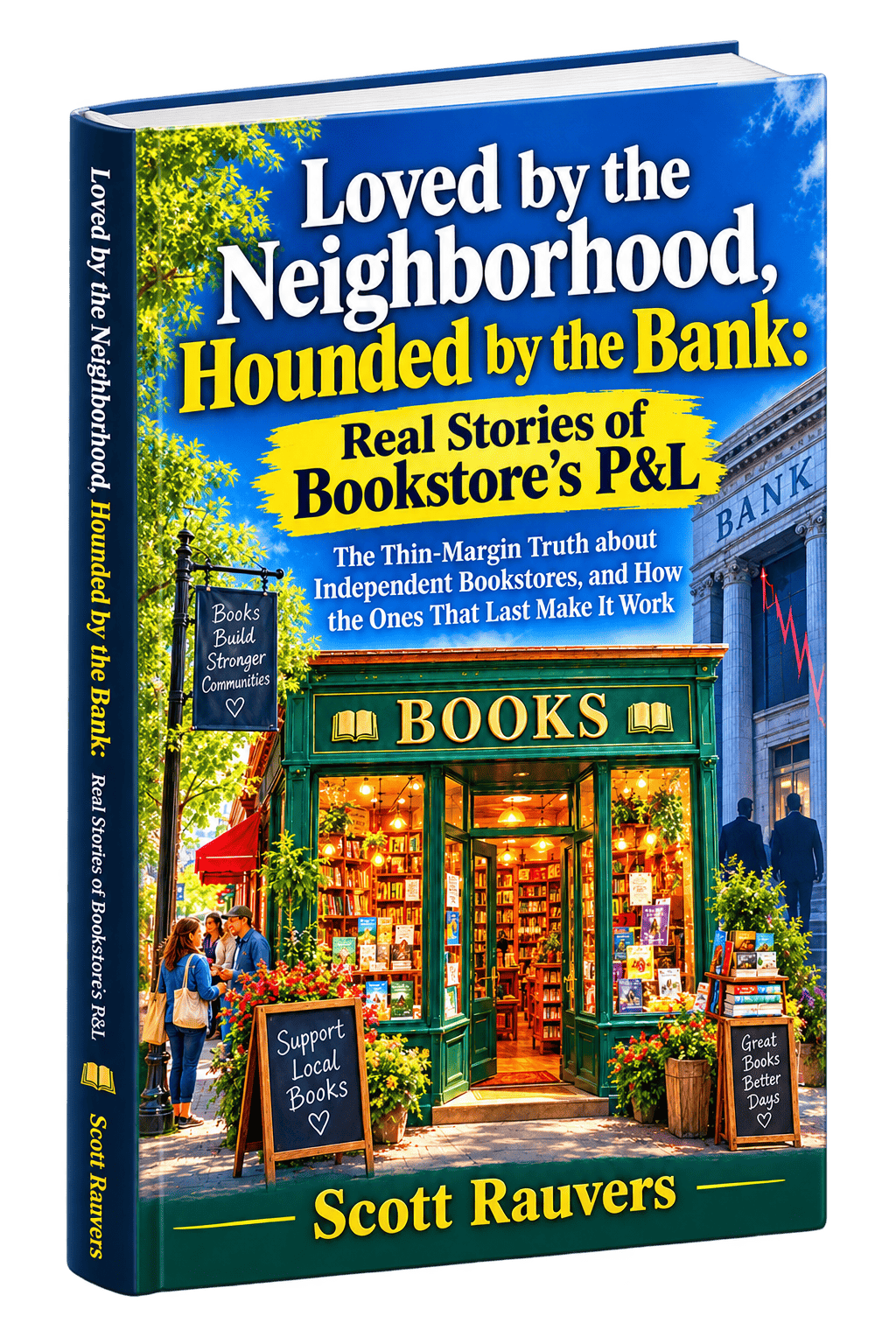
Loved by theNeighborhood,Hounded bythe BankReal Stories of Bookstore’s P&L
The thin-margin truth about independent bookstores, and how the ones that last make it work.
Scott Rauvers
Loved by the Neighborhood,Hounded by the Bank
Real Stories of Bookstore’s P&L
−$4,980
SCOTT RAUVERS
You are invited to read free chapters of this book.
The register is a measuring instrument.
Published October 2026 ISBN 9798162601357
The Register Is a Measuring Instrument
A cash register does very little. It records what was sold, adds the tax, and opens a drawer. Yet it is the place where nearly every pressure on a small shop meets in one number.
~ 9 ~
Loved by the Neighborhood, Hounded by the BankRAUVERS
Love doesn’t pay the rent.
One February, a much-loved bookstore took in $33,171 and still lost $4,980. Nobody was careless. It was just arithmetic.
Real numbers, real stores, and 35 real problems worked through to a bottom line.
ISBN 9798162601357
Drag to turn the book. Tap it to open.
One February, a much-loved bookstore took in $33,171 and still lost $4,980. This book opens the register and shows you exactly why, and what the stores that last do differently.
Everyone loves the little bookshop on the corner.Love doesn’t pay the rent.
One February, a much-loved bookstore in Ithaca, New York, took in $33,171 and still lost $4,980. Nobody was careless. It was just arithmetic.
Once the books, the staff and the landlord were paid, the store was already $509 in the red before a single other bill came in. That’s the story hiding behind every shop you’ve ever admired from the sidewalk, and it’s why this book starts with a real month of real accounts instead of a theory.
Run the what-ifs on the real numbers
Illustrative arithmetic on the store’s published figures. The receipt updates live.
From Chapter 2, “The Math of Micro-Margins.” Source: the Buffalo Street Books financial ledger for February 2023, published in Amy Reading’s serialized account Open Book.
BUFFALO STREET BOOKSIthaca, New YorkProfit and loss, February 2023
Sales$33,171100%
Cost of the books sold−$18,76156.6%
Gross margin$14,41043.4%
Payroll−$11,37434.3%
Rent−$3,54510.7%
Before any other bill−$509
Everything else−$5,16315.6%
Gifts and donations+$692
Net operating result−$4,980
Running total−$4,980
Thank you for shopping local. Love doesn’t pay the rent.
IN THE RED
The store’s own published numbers. The arithmetic between the lines is the author’s.
Small numbers. Closed doors.
The margin of safety in a bookstore is a few percentage points of sales. Feel how quickly it goes.
A 20 percent discount can cut the profit on a book in half.
A $10 book costs the store about $6 from its supplier, which leaves $4. Give the customer 20% off and that $4 becomes $2, so the store has to sell two copies to earn what one used to.
Shelf price
$8.00
Store keeps per copy
$2.00
Copies to match one full-price sale
2.0
Each spine is one copy the store must sell to earn the $4 one full-price sale would have.
Chapter 2. Stores typically pay roughly half to sixty percent of list price (NPR’s Planet Money, 2026); the $10 illustration comes from a former bookstore operator.
One surprise $3,000 repair can cost five times what a real bookstore earned in a year.
In 2021 Buffalo Street Books had net sales of $594,693 and net income of 0.1 percent: about $595 for the whole year. Chapter 4, “The Broken Compressor,” is about the bill that arrives uninvited.
A year’s net income$595
One broken compressor$3,000
5.0×
the store’s entire year of profit, gone to one repair.
Chapter 2 and Chapter 4. A store that earns 4 percent on $600,000 keeps about $24,000 a year.
19 days.
That’s how long the typical retail business could keep paying its usual bills if the till went silent tomorrow.
19days of cash, out of a 30-day month
The JPMorgan Chase Institute measured the “cash buffer” of about 597,000 small businesses: the number of days each could keep paying its usual outflows from its balance without taking in any revenue. The median was 27 days. Retail held 19. Restaurants, 16.
Count your own days
19.0days before the account runs dry, right at the retail median.
Median cash buffer by industry, in days
Chapter 1. JPMorgan Chase Institute (2016), deposit accounts of about 597,000 small businesses using 2015 transactions. Covers Chase customers only; credit lines and owner loans are not included.
Half are gone in five years.
The U.S. Bureau of Labor Statistics follows every new private-sector establishment and counts how many are still open as the years pass. Across three decades, the shape barely moves.
Open after 1 year
79.6%
After 5 years
49.6%
After 10 years
33.6%
The cohort that opened in the year ending March 1994, followed for a full ten years.
The sharpest losses come early. About one in five is gone after twelve months; survivors disappear more slowly afterward.
The shop and the household blur. Among small firms carrying debt, 59 percent had given a personal guarantee (Federal Reserve Small Business Credit Survey, 2026).
And still the doors keep opening. 605 independent bookstores opened in 2025, the fifth year in a row with more than 200 (American Booksellers Association).
Chapter 1. The table counts establishments, not owners, and every private industry, not retail alone. Not every closure is a failure: Chapter 11 explains why roughly a third of closed businesses were successful when they closed.
The rent on the listing is only the start of the bill.
Many retail leases are triple-net. Base rent is just one line; your share of the building’s costs rides on top.
Your spaceOther tenantsVacant
Base rent+Property taxes+Insurance+Common-area maintenance=What you actually pay
CAM charges are estimated at the start of the year, billed monthly, then reconciled after the year closes. That year-end true-up is one of the most common cost shocks tenants face. Caps often cover only “controllable” costs, audit rights must be negotiated, and the way a landlord counts the building’s space can quietly raise your share.
The CAM calculator
A 50,000 sq ft property with $250,000 a year in common-area costs.
Your share
10.0%
Per year
$25,000
Per month
$2,083
A 30 percent rent increase at renewal on a $3,545 rent adds about $1,064 a month, or $12,760 a year, against a year’s net income of about $595. That turns a break-even year into a loss of more than $12,000.
Chapter 3, “The Lease Trap.” Vacancy compounds: in April 2026 about 11.0 percent of New York City’s 142,000 storefronts were vacant, and a storefront within 250 feet of an empty one was more likely to be empty itself (NYC Comptroller, 2026). Nothing here is legal advice; the book’s advice is to have a tenant’s attorney read the lease actually on the table.
Four stores. Four ways the story goes.
Real names, real places, and what each register knew before anyone else did.
Salt Lake City, since 1929
The shop that grew, shrank and moved whenever it had to.
The Weller family’s bookstore was founded in 1929 and spent about fifty years in a large downtown building. In 2012 it moved to a smaller space in a different location. Its owners credit their survival to continual change: growing when it was time to grow, and contracting when it was time to contract.
When the story reached a technology forum, the most popular reply said a retailer that owns its building can weather almost any storm. The book weighs that claim against what property taxes, moving costs and an owned building actually do.
LastedNearly a century and counting.
The leverHow it held its space, not just what it sold.
West Hollywood, Melrose Avenue, 1970 to December 31, 2011
The Bodhi Tree: a landmark that succeeded its way out of business.
Founded in 1970 by Stan Madson and Phil Thompson, two former aerospace engineers, the Bodhi Tree became a tea-scented sanctuary for metaphysics, Eastern philosophy and holistic health. At its height in the late 1980s it employed around 100 people.
Then its niche went mainstream. Chains stocked whole New Age sections, online sellers made obscure texts a click away, and a fifteen-year slide in sales met the fixed cost of a large footprint on a rising commercial corridor. The owners sold the property and closed the doors.
“Proselytized itself out of business.”
Pressure point oneMarket dispersion: when a niche goes mainstream, the moat goes with it.
Pressure point twoThe fixed-footprint trap: space sized for the peak, paid for in the slide.
Ithaca, New York, worker-owned
Buffalo Street Books: the store that opened its books.
Almost no shop publishes its accounts. Buffalo Street Books did, month by month, in a serialized account by writer Amy Reading. That ledger is the only full set of monthly accounts for a real independent shop the author could find in public, and it anchors the book’s arithmetic.
Against the American Booksellers Association’s ABACUS benchmark for stores with $500,000 to $999,000 in sales, the store wasn’t wildly different on cost of goods or rent. Where it differed was personnel: 28.9 percent of sales against 24.8. Net income: 0.1 percent against an average of 6.2.
The findingMargins thin enough that profit and loss can turn on a single choice about wages.
The honestyEvery figure from the store’s own published statements.
Across the United States, 2025
The new wave: pop-ups and mobile stores rewriting the rules.
The trade association for independent bookstores reported that 605 independent bookstores opened in 2025 and that its membership grew 19 percent. It was the fifth consecutive year with more than 200 openings. Of the new stores, 106 were pop-ups and 77 were mobile.
The author reads that as new owners choosing formats that limit their exposure to the lease, the fixed footprint and the cash tied up on shelves. Chapter 10, “The Micro-Pivot,” takes it up, along with Harvard Business School research on how independents came back.
The signalSmaller, lighter, movable formats.
The caveatA count of openings without a count of closures is only half a ledger.
From diagnosisto rescue.
The first half of the book reads the register. The second half goes to work on what it finds.
35 real problems, worked throughEach with practical solutions, worked examples and a clear bottom line.
The Monthly Register CheckTen numbers you can start tracking tomorrow, so trouble shows up on paper before it shows up at the door.
Profit plans and solutionsA complete profit guide for independent bookstores at the back of the book.
Every source markedFull citations and references. Government tables, central-bank reports and peer-reviewed studies are flagged so you can check them yourself.
Lived, not theorizedNearly two decades of the author’s own businesses and in-person conversations with owners up and down the West Coast.
Four frameworks run through it
Adaptive merchandising. Spot a niche going mainstream and move toward curated, hard-to-copy experiences before the market share goes.
Capital protection and lease negotiation. Flexible terms, predatory clauses to catch, and reserves for the lean months.
Hybrid operations. Lean digital sales alongside the storefront, capturing online demand without adding overhead.
The exit-or-pivot protocol. Clear financial triggers for downsizing, restructuring or closing before it becomes ruin.
Written for
Owners who want the doors open next yearDreamers about to sign a leaseRegulars who want their favorite store to last
Built on the public record
U.S. Bureau of Labor Statistics
Federal Reserve Small Business Credit Survey
Federal Reserve Board
JPMorgan Chase Institute
American Booksellers Association
Harvard Business School
The Nilson Report
NYC Comptroller
NPR Planet Money
Open Book, Buffalo Street Books
Pull a chapter off the shelf.
Each spine is as thick as its chapter. The introduction and first three chapters are free to read today.
Introduction
Introduction: The Register Is a Measuring Instrument
Rent, wages, stock, the card network’s fee, Tuesday’s repair bill and the neighbor who loves the store but bought online anyway: every pressure on a small shop meets in one number. Plus the Bodhi Tree, and why this book studies bookstores.
Turn the pages here, then download the introduction and first three chapters free.
Introduction
The Register Is a Measuring Instrument
A cash register does very little. It records what was sold, adds the tax, and opens a drawer. Yet it is the place where nearly every pressure on a small shop meets in one number. Rent, wages, the price of stock, the fee a card network takes, the repair bill that arrived on Tuesday, and the neighbor who said she loves the store but bought online anyway: all of it has to be paid for out of the receipts that pass through that drawer, and none of it waits for a good month.
~ 9 ~
Introduction
This book is about that edge. […] It asks a simple question that turns out to have a complicated answer: why is it so hard for an independent storefront to stay open, and why do people keep opening them anyway?
The answer I arrived at has four parts. First, the arithmetic of a small shop is unforgiving, because the largest costs are fixed or semi-fixed and the margin left after them is thin. Second, shocks arrive on a schedule the owner does not control, and a thin margin leaves little room to absorb them.
~ 10 ~
Introduction
Third, the work is physically and emotionally demanding in ways that spreadsheets cannot ever capture. Fourth, the shops that last tend to be the ones that change what they sell, how they sell it, or how they hold their space, and sometimes the right change is to close on purpose.
None of these claims is original, and I found that each has more evidence behind it than a skeptic might expect.
~ 10 ~
Introduction
For nearly four decades, the Bodhi Tree Bookstore in Los Angeles, California stood as a vibrant sanctuary for spiritual seekers, free thinkers, and literary wanderers in West Hollywood. Founded in 1970 by Stan Madson and Phil Thompson—two former aerospace engineers who abandoned the defense industry to pursue a deeper calling—the bookstore was named after the ancient sacred fig tree under which Siddhartha Gautama attained enlightenment.
Nestled on Melrose Avenue, the shop was far more than a commercial enterprise; it was a peaceful, tea-scented oasis.
~ 12 ~
Introduction
When they first opened in 1970, books on Eastern spirituality, alternative healing, and metaphysics were obscure, hard-to-find niche items. However, over the course of four decades, these topics moved into the mainstream. […]
As Madson once wryly observed, the store had effectively “proselytized itself out of business” as its specialized material became widely dispersed across the mainstream market.
~ 14 ~
Chapter 1: Key in the Lock
Key in the Lock
Opening a shop is an act of optimism, and I do not think optimism is a flaw. Nobody signs a lease expecting to fail. The question I wanted to answer in this chapter was how optimism should be sized against the arithmetic that waits on the other side of the door, and the first piece of arithmetic is the plainest: how many new businesses are still open after a few years.
~ 21 ~
Chapter 1: Key in the Lock
When a cost is fixed, the share of revenue it consumes rises in a quiet month and falls in a busy one. A shopkeeper in the first month of trading, with no regulars yet, is exposed to the high end of that range.
No amount of enthusiasm changes the fact that the landlord is paid on the first of the month whether or not people came in. The dream arrives as a feeling; the overhead arrives as a schedule.
~ 29 ~
Chapter 2: The Math of Micro-Margins
If a store gives a customer a 20 percent discount on that $10 book, its $4 gross margin falls to $2, so the store must sell two copies to earn what it would have earned from one.
A discount that feels like a small gesture to the customer halves the gross margin on the item.
This is exactly the kind of mechanical force I set out to understand, and it convinced me that shops competing on price against much larger sellers are fighting on the wrong ground.
~ 36 ~
Chapter 3: The Lease Trap
The Lease Trap
The lease is the binding legal document that decides how much room a shop has to maneuver. It is also the document least likely to be read carefully by a first-time owner, because it arrives at the moment of greatest enthusiasm and is written in the vocabulary of commercial real estate.
~ 41 ~
Keep reading.
The introduction and the first three chapters are free, in full.
Straight answers from the book’s sources on independent bookstore economics.
Why do independent bookstores close?
The book’s answer has four parts. The largest costs are fixed or semi-fixed and the margin left after them is thin. Shocks arrive on a schedule the owner does not control. The work is physically and emotionally demanding. And the shops that last change what they sell, how they sell it, or how they hold their space. Sometimes the right change is to close on purpose.
What are typical bookstore profit margins?
Thin. A Publishers Weekly editorial cited in Harvard Business School research put independent bookstore net operating margins at zero to four percent. The ABA’s ABACUS benchmark average was 6.2 percent for stores with $500,000 to $999,000 in sales. Buffalo Street Books earned 0.1 percent in 2021. The book treats zero to six percent as the plausible band for a stable, well-run store.
What does a real bookstore profit and loss statement look like?
The ledger above is one: Buffalo Street Books, February 2023. Sales of $33,171; cost of goods $18,761; payroll $11,374; rent $3,545; other expenses $5,163; gifts and donations $692. Net operating loss: $4,980. It is a rare, complete retail store P&L example from a real independent shop.
What is the cost of goods sold for bookstores?
Stores typically pay roughly half to sixty percent of a book’s list price. Buffalo Street Books ran 56.6 percent in February 2023 against its own target of 53 to 54 percent. The ABACUS benchmark average was 55.2 percent.
How much does it cost to run a physical bookstore?
In one real February, a store with $33,171 in sales spent $38,843: books, payroll, rent and everything else. Rent was 10.7 percent of sales that month but about 7 percent across 2021. Retail store fixed overhead costs don’t change with sales, so their share balloons in a quiet month.
What is a retail triple net lease (NNN), and what are the hidden costs?
Commercial lease hidden costs start with the structure. In a triple-net lease the tenant pays base rent plus a pro rata share of property taxes, insurance and common-area maintenance. CAM is estimated, billed monthly, then reconciled after the year closes, and the year-end true-up is one of the most common cost shocks. Caps often apply only to controllable costs, audit rights must be negotiated, and if the landlord divides by occupied rather than total space, vacancies push a larger share onto the tenants who remain.
How many days of cash does a small business have?
Measured in small business cash buffer days, the JPMorgan Chase Institute found a median of 27. Retail held 19 days, restaurants 16, personal services 21, healthcare 30 and real estate 47.
What is the small business survival rate, according to the BLS?
Of establishments that opened in the year ending March 1994, 79.6 percent were operating a year later, 49.6 percent after five years and 33.6 percent after ten. For the 2019 cohort, 79.2 percent survived one year and 51.5 percent five years. On independent bookstore survival rate statistics specifically, the ABA reports openings (605 in 2025) but no closure count, which the book calls only half a ledger.
What do credit card interchange fees for retail actually cost?
Federal Reserve data put average debit interchange at about 0.47 percent of the transaction for covered issuers and 1.21 percent for exempt issuers, with network fees adding roughly 0.28 percent. U.S. merchants paid a record $160.70 billion in processing fees in 2022 (Nilson). The book puts card processing at one to three percent of card sales: about $500 a month for a store selling $33,171.
What happened to the Bodhi Tree Bookstore in Los Angeles?
The short version of the Bodhi Tree Bookstore Los Angeles history: 1970 to 2011. Founded on Melrose Avenue by former aerospace engineers Stan Madson and Phil Thompson, it became a landmark for metaphysics, Eastern philosophy and holistic health, employing around 100 people at its late-1980s peak. As its niche went mainstream, sales slid for fifteen years. The owners sold the property and the store closed on December 31, 2011.
How to open an independent bookstore without losing your shirt?
Size optimism against the arithmetic. Benchmark your bookstore business plan financials against ABACUS ratios for your sales band (cost of goods 55.2 percent, personnel 24.8, rent 6.3, net income 6.2 for $500,000 to $999,000 stores). Compare spaces on full occupancy cost, not base rent, because rent and CAM are priced by the square foot; bookstore revenue per square foot matters as much as total sales. Hold a real cash buffer, and have a tenant’s attorney read the lease.
What are retail commercial vacancy rates right now?
The New York City Comptroller counted about 142,000 storefronts in 2026, roughly 15,700 vacant: 11.0 percent as of April 2026. A storefront within 250 feet of a vacant one was more likely to be vacant itself (15.4 percent). National retail vacancy was about 4 percent in 2024.
Nearly two decades of the author’s own businesses, 1997 to about 2015.
Scott Rauvers
Independent researcher, author, and someone who has signed the lease himself.
He has been on the other side of the counter.
From 1997 to about 2015, Scott ran businesses of his own across California, Oregon and Hawaii. Some were very successful and some failed. Along the way he talked with hundreds, if not thousands, of independent shop owners in person, including people at the famous Powell’s Books in Portland. This book is the record of what he went looking for, what he calculated, and what the data and those years taught him.
He is also the founder of The Institute for Solar Studies on Behavior and Human Health. His catalog runs from solar physics, geophysics and phytotherapy to human longevity, cognitive optimization, business economics and personal development, always with one method: distill rigorous data into clear frameworks that save readers countless hours of study.
Whether you own a shop, dream of opening one, or just want your favorite store still standing next year, this book tells you what the register already knows.
Loved by the Neighborhood,Hounded by the Bank
Real Stories of Bookstore’s P&L
−$4,980
SCOTT RAUVERS
Loved by the Neighborhood, Hounded by the BankRAUVERS